
Got a collection idea but worried about boxes of unsold stock? Low MOQ fabric is not about producing as little as possible; it is about producing just enough to learn what your customers actually buy. This guide shows you how to test designs and fabrics with a limited quantity, with real MOQ numbers, a production timeline, and the signs that your brand is ready to scale up.
How do you test-market a fashion brand with a low MOQ? Pick your 2–3 strongest designs, produce a small run (for example, 25 meters of fabric per design), and sell through pre-orders or a limited drop. Track sales and customer feedback for a few weeks. Reorder the designs that sell in larger quantities, and review the slow ones without being left with piles of stock.
What is MOQ and why does it matter for a new brand?
MOQ (minimum order quantity) is the smallest order a supplier will accept in a single purchase. For fabric, MOQ is usually counted in meters per design or meters per color.
Suppliers set an MOQ because every production run carries fixed costs: file preparation, machine setup, color checks, and admin. Those costs do not shrink when the order does. As a result, the higher the MOQ, the more cash you lock into stock before you know whether customers like the product.
For a new brand, the MOQ decides three things at once:
- Upfront capital tied up in raw materials.
- How many designs you can try in one collection.
- The risk of unsold stock if your design guess is wrong.
Why should a new fashion brand test the market first?
A market test proves which designs people will actually pay for before you commit serious money. Without one, production decisions rest on guesswork and personal taste.
The idea mirrors the minimum viable product (MVP) concept from the startup world. An MVP is a version of a product that is good enough to sell to early customers, so a business can learn from real market response at the lowest possible cost. In fashion, your MVP can be a small drop of 2–3 prints on a single fabric.
Unsold stock is also becoming a bigger issue globally. Under the Ecodesign for Sustainable Products Regulation (ESPR), the European Union bans large companies from destroying unsold clothing and footwear from July 19, 2026, with medium-sized companies expected to follow in 2030. The rule does not apply to a small brand starting out, but the direction is clear: overproduction is increasingly seen as wasted capital and an environmental burden.

What is the MOQ for custom fabric printing at Zalmon Fabric?
Zalmon Fabric accepts custom digital printing on natural-fiber fabric from 50 meters for 2 designs, or 25 meters per design. For polyester, Zalmon Fabric’s custom print MOQ starts at 10 meters. You can see the full service on the custom digital fabric printing page.
Digital printing is a technique that prints a design straight from a digital file onto fabric, without making screens or engraved cylinders. Because there is no screen cost per design, it is the most sensible option for small quantities and varied designs.
| Service | MOQ | Best for |
|---|---|---|
| Custom digital print, natural fibers | 50 m for 2 designs (25 m per design) | Test-marketing a first collection with exclusive prints |
| Custom print on polyester | 10 m | Testing a design with the smallest fabric budget |
| Print only (your own fabric) | 300 m | Brands that already hold their own fabric stock |
| Custom dyeing | 300 m per color per fabric type | Custom solid colors at mid volume |
| Rotary printing | Confirmed per order | Large-volume reorders once a design has proven itself |
As a rough example, if one garment uses about 2.5 meters of fabric, 25 meters covers roughly 10 pieces per design. Work out your exact number with our guide on how much fabric you need for clothing, because fabric width, sizing, and pattern layout all change the result.
How do you test the market with low MOQ fabric?
The safest strategy is to start with a few designs, sell in a low-risk way, and decide on your next production run based on sales data. Here is a sequence you can follow:
- Pick your 2–3 strongest designs. Narrow your ideas down to the prints that best express your brand. Ask potential customers through an Instagram poll or a WhatsApp group before you produce anything.
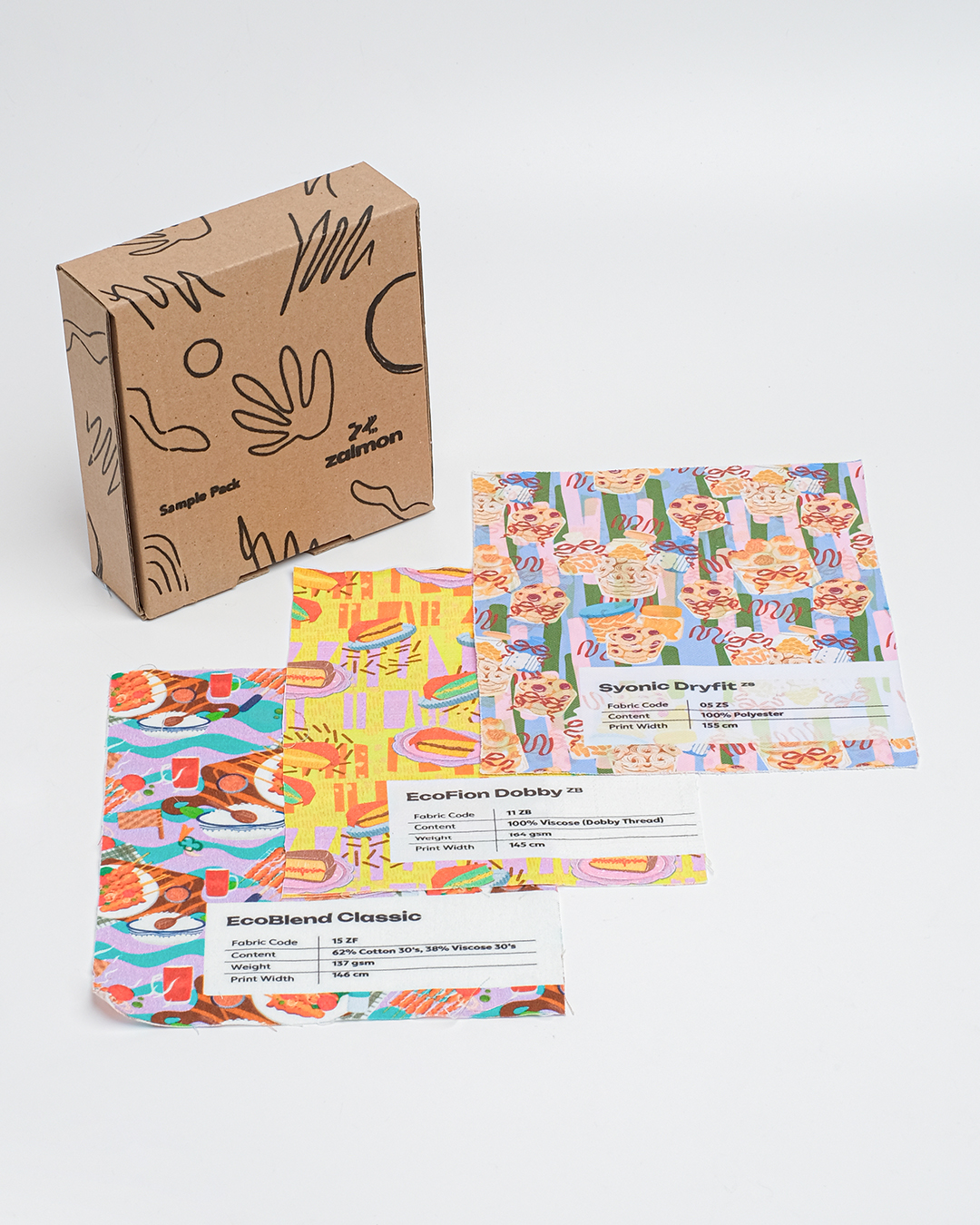
- Test fabrics with a sample pack. The Zalmon Sample Pack contains printed fabric swatch cards labeled with each fabric name, so you can judge texture, drape, and color results in your own hands.
- Start with one fabric type. Using a single base fabric for every design keeps the sales comparison fair, because you are testing the print, not the material. Choose it from the Zalmon Fabric fabric list.
- Ask for a strike-off before production. A strike-off is a trial print of your design on the actual fabric, used to check color and scale before the full run.
- Sell through pre-orders or a limited drop. Pre-orders signal demand before stock exists, while a limited drop creates urgency without a large production run.
- Measure the results. Record sell-through per design, the most requested sizes, and what customers say about the fabric and the print.
- Decide: repeat, adjust, or stop. Designs that sell out fast deserve a bigger reorder. Slow designs should be reviewed, not forced into another run.
Sell-through rate is the percentage of stock sold within a set period. For example, selling 8 out of 10 pieces in two weeks gives you an 80% sell-through.
How long does it take from design to finished fabric?
For custom digital printing at Zalmon Fabric, plan for at least 28–31 working days from strike-off to finished fabric, not counting review and sewing time. Here is the breakdown:
| Stage | Duration | Notes |
|---|---|---|
| Finalizing design files | Depends on you | Follow the Zalmon design terms to avoid file revisions |
| Digital print strike-off | 7–10 working days | Check color, print scale, and fabric feel |
| Review and approval | Depends on your decision | The faster you approve, the sooner you join the queue |
| Digital print production | From 21 working days | Normal queue |
| Sewing, photos, launch prep | Depends on your garment maker | Can run in parallel from the strike-off stage |
Zalmon Fabric’s working days are Monday to Friday; Saturdays and Sundays are off. If your launch date is fixed, count backwards in working days, not calendar days.
What are the most common test-market mistakes?
The most common mistake is testing too many variables at once, which makes the sales results impossible to read. Compare the habits that help with the ones to avoid:
Do
- Limit each drop to 2–3 designs.
- Use one fabric type first.
- Track sales by design and by size.
- Plan your reorder from the start.
Avoid
- Producing every idea at once.
- Changing fabric and print at the same time.
- Judging designs by likes alone.
- Waiting until you sell out to reorder.
When is a brand ready to scale up production?
A brand is ready to scale when one design sells consistently across several drops and you know which sizes and fabrics customers prefer. At that point, the stock risk is much lower because the production decision is based on data.
For reorders, you can keep using digital printing with larger quantities. For much larger volumes, Zalmon Fabric also offers rotary fabric printing on more than 25 natural-fiber fabrics; rotary MOQ and lead time are confirmed per order.
- Keep your final design files and approved strike-offs so every reorder stays consistent.
- With rotary printing, production color can vary ±5–10% from the sample, so order fabric for one style in a single run.
In short, low MOQ fabric is a learning tool. Start small, read your data honestly, and scale production only for the designs that have proven demand.
Zalmon Fabric is a natural-fiber fabric supplier (TENCEL™, cotton, rayon/viscose, silk, linen) and custom digital fabric printing service based in Bandung, Indonesia. Fabrics are woven and printed in-house at its own mill, with OEKO-TEX and Lenzing certifications. Showroom: Ruko 23 Paskal B71, Bandung 40181, Indonesia. WhatsApp: +62 813-2282-8217.
Frequently Asked Questions
What is the fabric MOQ for a new brand at Zalmon Fabric?
At Zalmon Fabric, the MOQ for custom digital printing on natural-fiber fabric is 50 meters for 2 designs, or 25 meters per design. For polyester, the custom print MOQ starts at 10 meters. This lets a new brand test several prints without ordering hundreds of meters.
What is the difference between pre-orders and a limited drop?
Pre-orders sell a product before it is made, so stock follows actual orders, while a limited drop produces a small quantity first and sells it within a short window. Pre-orders save capital, and limited drops get products to customers faster. Many brands combine both.
How long does custom fabric printing take at Zalmon Fabric?
A digital print strike-off at Zalmon Fabric takes 7–10 working days, and production in the normal queue takes at least 21 working days. Saturdays and Sundays are not counted, so plan your launch in working days.
Do I need to supply my own designs?
Yes, Zalmon Fabric prints designs supplied by the customer, so you prepare your own print files. Make sure your files follow the Zalmon design terms so the result matches your expectations and the strike-off goes smoothly.
How can I choose a fabric without buying a lot?
Use a sample pack to compare several fabrics at once. Holding real fabric swatches lets you judge texture, drape, and print color before you choose the base fabric for your first run.
What is sell-through rate?
Sell-through rate is the percentage of stock sold within a set period. For example, selling 8 out of 10 pieces in two weeks means an 80% sell-through. It helps you decide which designs deserve a reorder.
Ready to test your first collection?
Tell us about your designs and how many pieces you plan to sell. The Zalmon Fabric team will help you estimate fabric quantities and map out the schedule from strike-off to production.
Chat via WhatsApp →Get the Sample PackShowroom: Ruko 23 Paskal B71, Bandung, Indonesia.