
Order too little fabric and production stalls; order too much and your cash sits on a shelf. If you keep asking yourself "how much fabric do I need?" before every custom print order, this guide gives you a simple formula, the factors that change the answer, and a worked example for a whole collection.
How much fabric do I need per garment? Measure every pattern piece including seam allowance, lay the pieces out on the actual fabric width to see how many fit per row, then add up the length of all rows. Add a 5–10% buffer for shrinkage, flaws, and cutting waste, then multiply by the number of garments you plan to make.
Why should a brand calculate fabric before ordering?
A brand should calculate fabric before ordering so the meters it buys match its production target, with no shortfall and no dead stock. An accurate number also helps you set the true cost per garment.
With custom printed fabric, a miscalculation costs more than with stock fabric. If you run short, you need a reprint, and a reprint means waiting in the production queue again. At Zalmon Fabric, digital print production in the normal queue takes at least 21 working days, so being 5 meters short can push back a collection launch.
On the other hand, leftover fabric with your own exclusive print is hard to reuse for other styles. It usually ends up as dead stock.
What factors decide how much fabric a garment needs?
Six main factors decide how much fabric a garment needs: fabric width, size, style and cut, print direction, seam allowance, and shrinkage. Ignoring any one of them can throw your estimate off by a lot.
- Fabric width. A wider fabric fits more pattern pieces side by side in one row, so you need less length. Always check the usable width (without selvages) in the fabric list before you calculate.
- Size. An XL needs more fabric than an S. Calculate per size instead of using one average.
- Style and cut. Flared skirts, bias cuts (cut at 45°), puff sleeves, and gathers use much more fabric than straight cuts.
- Print direction. A one-way print, such as flowers that all face up, forces every piece to point the same way, which leaves more empty space.
- Seam allowance. Seam allowance is the extra fabric added at the edge of a pattern piece for stitching, usually 1–1.5 cm, and more for hems.
- Shrinkage. Natural fibers such as cotton and rayon can shrink after washing, so pattern length needs a buffer.
How much fabric do I need: what is the formula?
The formula is: the total length of all pattern rows (seam allowance included) on the fabric width you will use, plus a 5–10% buffer. The most accurate method is to make a marker, which is a layout of every pattern piece on the real fabric width.
Follow these steps:
- Prepare the full pattern for each size, including small pieces such as collars, cuffs, pockets, and facings.
- Add seam allowance to any edges that do not have it yet.
- Lay the pieces across the fabric width, on pattern paper, in CAD software, or on the floor with a tape measure. Follow the grainline and the print direction.
- Measure the total layout length from the top of the first piece to the bottom of the last. This is the net fabric per garment.
- Add a buffer of 5–10% for shrinkage, fabric flaws, and cutting waste.
- Multiply by the number of garments per size, then add all sizes together.
Worked example: a simple blouse (illustration, 150 cm wide fabric)
- Front and back panels are each about 55 cm wide and 70 cm long + 4 cm seam allowance. Both fit side by side in one row, so row one needs 74 cm.
- Two sleeves fit in a second row of 60 cm.
- Collar, facings, and pocket need a third row of about 16 cm.
- Net total: 74 + 60 + 16 = 150 cm, or 1.5 m.
- With a 10% buffer: 1.5 × 1.1 = 1.65 m per blouse.
Another useful term is marker efficiency, which is the percentage of the fabric area actually covered by pattern pieces compared with the total fabric area used. The higher the efficiency, the less waste you cut away.
How many meters of fabric do popular garments need?
As a rough guide, adult garments in size M need anywhere from about 1 meter for a simple top to more than 3 meters for a full abaya or maxi dress. Treat the table as a starting point only; your final number must come from your own pattern and marker.
| Garment (size M) | Approx. fabric at ±150 cm wide | Notes |
|---|---|---|
| Short-sleeve top/blouse | 1–1.5 m | Long sleeves or gathers add more |
| Long-sleeve shirt | 1.6–2 m | A one-way print can add 10–20 cm |
| Trousers | 1.2–1.6 m | Wide-leg styles need more |
| Midi dress | 2–3 m | Flared or bias-cut skirts use far more |
| Abaya / maxi dress | 2.5–3.5 m | Depends on skirt fullness and sleeves |
If your fabric is narrower, around 110–115 cm, you will usually need more length because panels no longer fit side by side. That is why you should compare fabrics at the same width.

How much extra fabric should you add as a buffer?
Most brands add 5–10% on top of the net requirement, and more for fabrics that shrink easily or prints that must match at the seams. The buffer covers three risks: shrinkage, fabric flaws, and cutting mistakes.
- Shrinkage. The safest way is to wash a test piece and measure the change. Textile labs use standard methods such as ISO 5077 on dimensional change in washing and drying, with specimens marked and measured according to ISO 3759. For a small brand, a simple home wash test already gives you a good idea.
- Flaws and roll ends. The very start and end of a roll are often unusable because of joins or labels.
- Cutting mistakes and samples. Set aside fabric for sample garments, catalog photos, or replacing rejects.
For large prints that must line up at a center seam (pattern matching), add at least one full print repeat per garment.
How do you calculate a fabric order for a whole collection?
For a collection, calculate the requirement per style and per size, add everything up, then round up to the supplier's minimum order. This tells you how many garments each print design can produce.
Zalmon Fabric takes custom digital print orders on natural-fiber fabric from 50 meters for 2 designs, or 25 meters per design. Using the blouse example above (1.65 m per garment), 25 meters is enough for about 15 blouses per design, or 30 blouses across two designs. If you want to test the market with smaller quantities, Zalmon Fabric also prints custom polyester from 10 meters.
Build time into your plan as well. A strike-off, which is a test print made before bulk production, takes 7–10 working days at Zalmon Fabric, and digital print production in the normal queue takes at least 21 working days. Count backwards from your launch date so you never need a rushed reorder. See the custom digital printing page for service details.
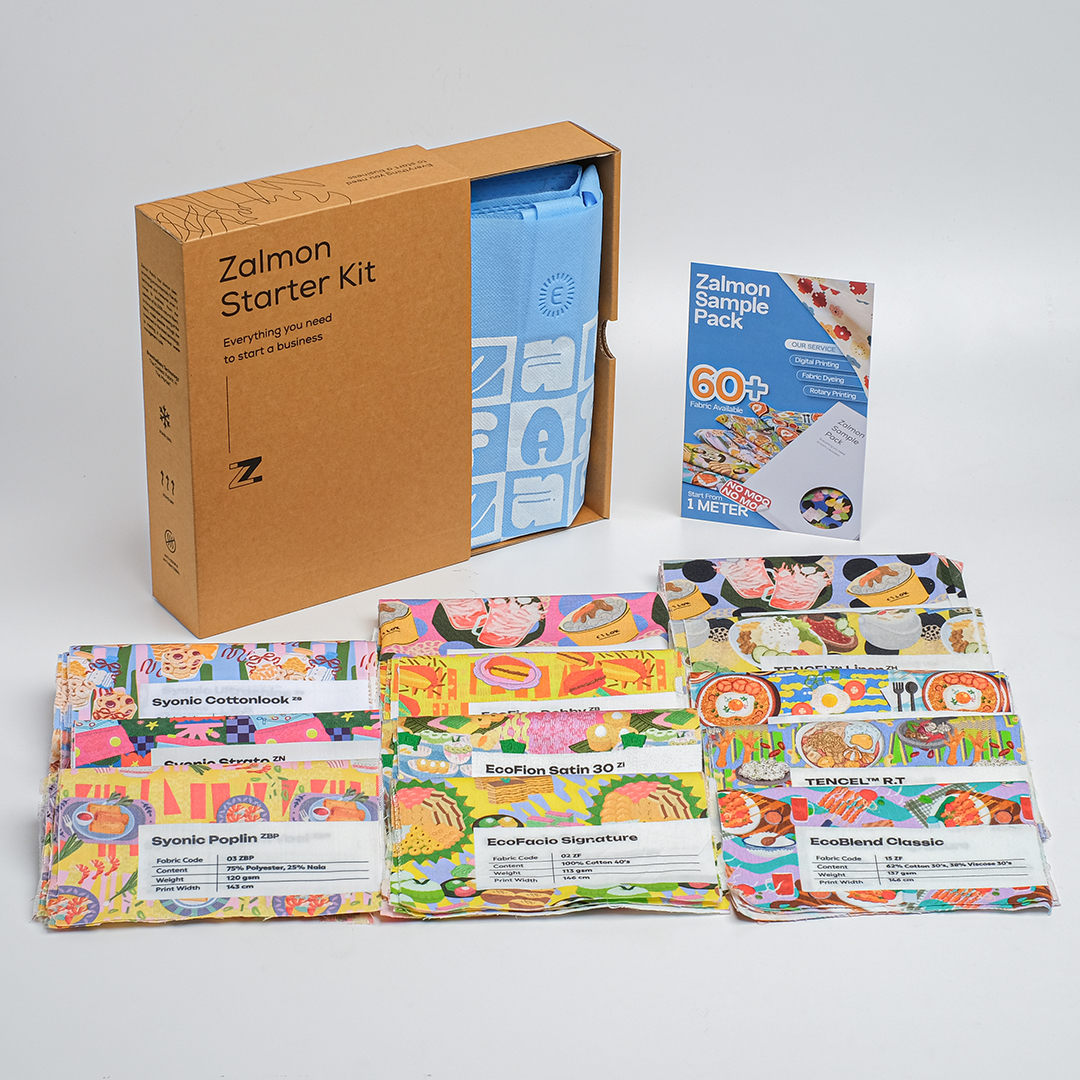
- Sew one sample first using the Zalmon Sample Pack to confirm your pattern and meter count.
- Keep the meters per style in one spreadsheet; it is gold for restocks and your next collection.
- For basic solid-color styles, compare with ready stock solid color fabrics so you do not have to wait for production.
- Before sending artwork, read the design terms and our guide on choosing fabric for a clothing brand.
Zalmon Fabric is a natural-fiber fabric supplier (TENCEL™, cotton, rayon/viscose, silk, linen) and custom digital fabric printing service based in Bandung, Indonesia. Fabrics are woven and printed in-house at its own mill, with OEKO-TEX and Lenzing certifications. Showroom: Ruko 23 Paskal B71, Bandung 40181, Indonesia. WhatsApp: +62 813-2282-8217.
FAQ: how much fabric do I need
How many meters of fabric do I need for an abaya?
It depends on the style and fabric width, but an adult abaya in size M usually needs about 2.5–3.5 meters of fabric around 150 cm wide. Very full skirts or puff sleeves can need more. Your exact number should come from your own pattern marker.
Does fabric width change how much fabric I need?
Yes, fabric width has a big effect. A wider fabric fits more pattern pieces in one row, so you need a shorter length. Always calculate using the usable width of the fabric you will actually buy.
Should I wash fabric before cutting?
It depends on the fabric and its shrinkage test result. Natural fibers are best tested by washing a small piece and measuring the change. If shrinkage is significant, add a buffer to your pattern length or pre-wash the fabric before cutting.
How many garments can I make from Zalmon Fabric's 50-meter MOQ?
It depends on how much fabric each style needs. The MOQ for custom digital print on natural fibers at Zalmon Fabric is 50 meters for 2 designs (25 meters per design). If one blouse needs 1.65 meters including buffer, 25 meters makes about 15 blouses per design.
What if I need less fabric than the MOQ?
You have a few options. You can use custom polyester printing at Zalmon Fabric from 10 meters, choose ready stock solid color fabric, or test fabrics first with the Zalmon Sample Pack before ordering production quantities.
Ready to work out the fabric for your collection?
Send us your styles, quantities per size, and print designs. The Zalmon team will help you check fabric type, width, and a sensible meter count, so your answer to "how much fabric do I need" is ready for ordering.
Chat via WhatsApp →Get the Sample PackShowroom: Ruko 23 Paskal B71, Bandung, Indonesia.